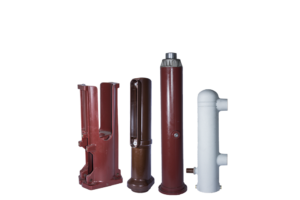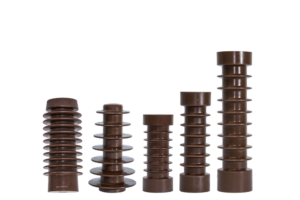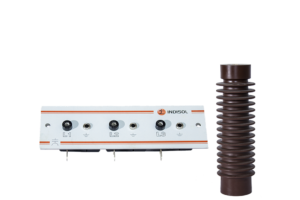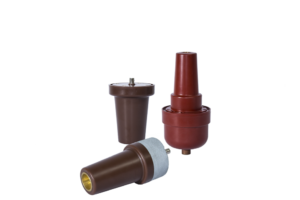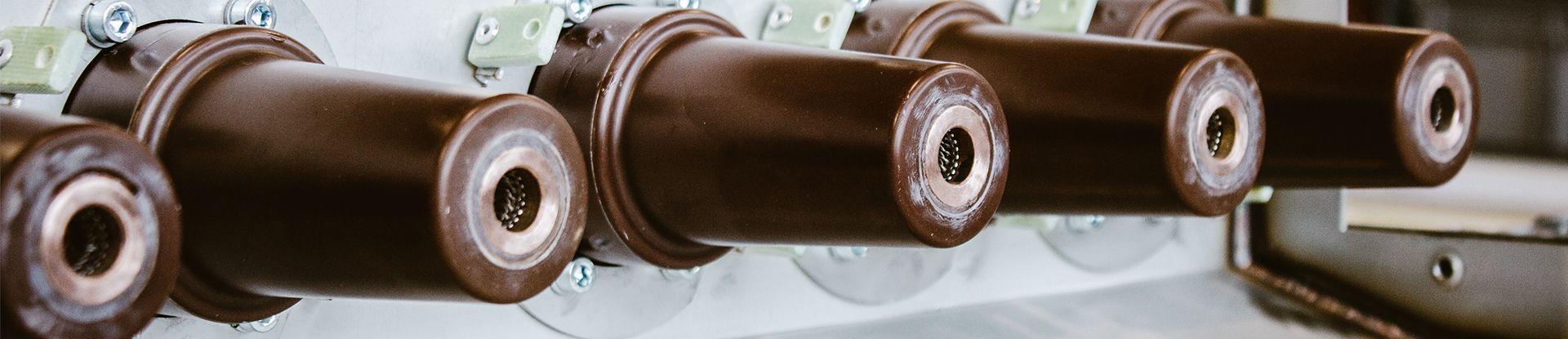
Cast epoxy insulators manufactured by Indisol

Epoxy Products

Capacitive Voltage Divider

Before anyone works on a medium voltage panel, one question has to be answered without doubt: is the busbar live? A capacitive voltage divider is the accepted way to answer it. The capacitance of the insulator itself forms the high voltage arm of the divider, a measuring capacitance completes it, and what comes out is a low voltage signal that follows the conductor faithfully enough to drive an indicator, a detection system or a measurement input.

Indisol casts that divider into the insulator that is already holding the conductor, across low, medium, high and very high voltage. The part keeps its structural job — it still supports the busbar — and gains the voltage indication function without a separate device taking up room in the panel.

Capacitive supporting insulators are dimensioned to correspond to conventional DIN insulators without coupling capacitance, so they go into an existing switchgear design as a direct replacement instead of forcing a redesign.

They are used in medium voltage switchboards, in industrial installations, and wherever work under voltage has to be prepared — which is where a reliable indication of the presence of voltage stops being a convenience and becomes a safety requirement.

Looking for something else? The full divider family, the three sensor technologies and the other insulator families each have their own page — the guide below points you to the right one.

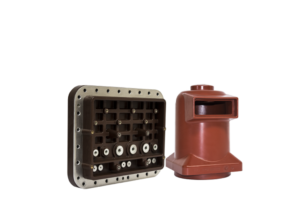
Capacitive divider insulator in cast epoxy for medium voltage switchgear, Indisol
Cast epoxy divider insulators for voltage indication systems, Indisol
Voltage indicator panel and capacitive divider insulator, Indisol

Capacitive divider insulators for voltage indication

20–40 kV/mmBreakdown strength of cast epoxy
LV to VHVVoltage classes we cast for
200 kVIn-house test ceiling
0.2%Accuracy class where the signal is also measured

Which epoxy insulator do you need?

“Epoxy insulator” is a family name, not a part number. A support insulator is one member of it. If the part you are specifying does something else, go straight to the right family.
Cast epoxy support insulator, Indisol
Support & post insulatorsHold a conductor away from earth and carry the mechanical load.See the range →
Medium voltage cast epoxy bushing, Indisol
BushingsTake a live conductor through a wall, an enclosure or a tank.See the range →
Cast epoxy components for gas insulated switchgear, Indisol
GIS productsBusbar supports, fuse tubes and breaker chambers inside gas insulated equipment.See the range →
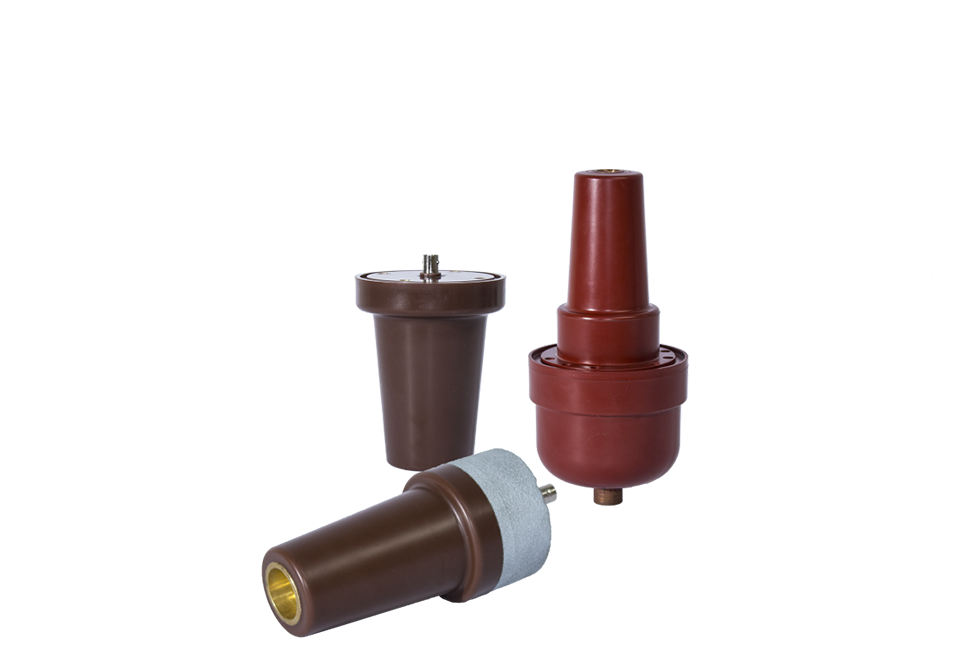
Cast epoxy insulator divider, Indisol
Divider insulatorsInsulate and, at the same time, give a low voltage signal that follows the conductor.See the range →
Medium voltage voltage sensors and indicators in cast epoxy, Indisol
Medium voltage sensorsMeasure voltage or current to a stated accuracy class.See the range →
Epoxy insulator with integrated sensing for smart grids, Indisol
SmartGridSensing, monitoring and PLC communication built into the insulating part.See the range →
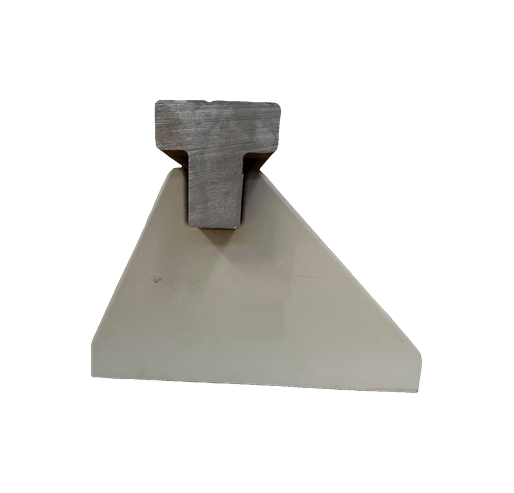
Third rail insulator supporting a T-section conductor rail, Indisol cast epoxy
Third rail insulatorsHold the conductor rail that powers a metro or light-rail line.See the range →
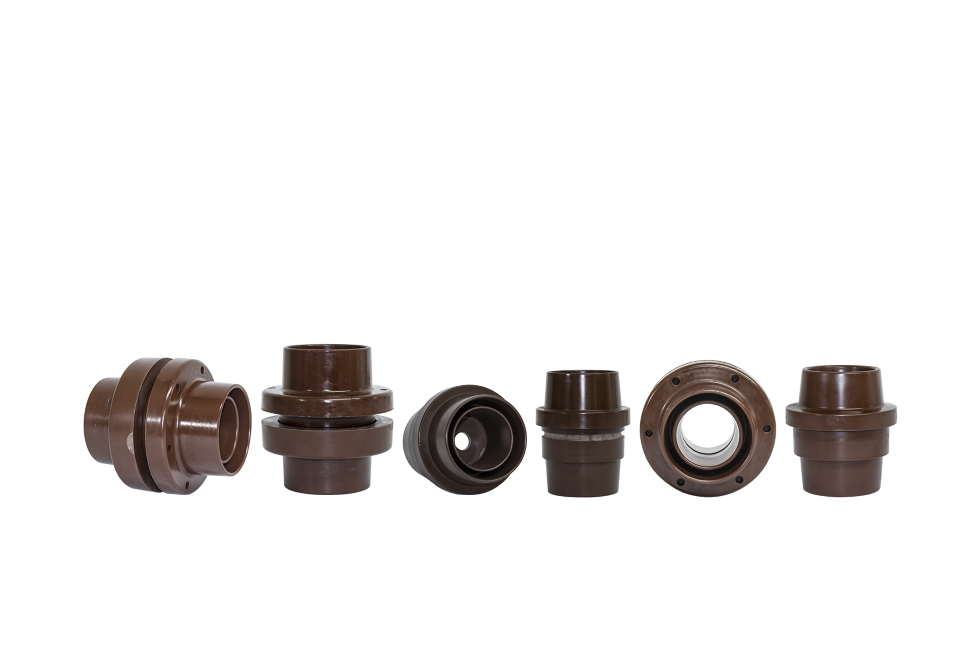
Customized cast epoxy product for medium and high voltage, Indisol
Custom HV/MV productsEpoxy housings for switches, and shapes none of the above describes.See the range →

Indoors or outdoors: the resin decides

Where the insulator lives still decides the resin, exactly as with any other part we cast. Both families cover low, medium, high and very high voltage.

IndoorsAromatic epoxyBisphenol A-epichlorohydrin resin with an anhydride hardener. Excellent dielectric performance where the surface is protected from weather.
OutdoorsCycloaliphatic epoxyFilled with pre-treated silica. Resists UV, tracking and weathering without the surface degradation that limits general-purpose resins. Also the choice indoors where there is humidity or pollution.
Polluted or coastalCycloaliphatic, overmouldedThe same resin with a silicone layer overmoulded on our own line, adding surface protection where the environment is aggressive.

Where neither standard family suits the duty, resin systems can be developed to specific electrical, thermal and mechanical requirements. More on our epoxy resin technology.

How a capacitive divider insulator is made

The division ratio is set by the geometry of the casting, so here the casting is the measurement rather than something the measurement is added to.

01PrepareResin degassed under vacuum, so the casting is free of voids. A void inside a divider is not only a partial discharge site — it is a change in the division ratio.
02CastGelation under pressure at temperature, with the electrodes encapsulated in the same shot, which is what holds the ratio from the first piece of a run to the last.
03FinishMetallization and sand blasting in house, so the electrode surfaces that define the capacitance stay under our own control.
04ProveElectrical testing plus amplitude and phase accuracy metrology on the finished part, in our own laboratory.

Specified to your panel, then measured

Cast epoxy has a breakdown strength of 20 to 40 kV/mm depending on the system. That is the material figure. What a divider insulator has to deliver is the withstand voltage of your system together with a division ratio you can rely on, so the insulation and the capacitance are dimensioned together rather than one after the other.

Operating voltages of 12, 24, 36 and 72 kV. Where the signal is used for measurement and not only for indication, accuracy classes with a measured value deviation of 0.2% or 0.5% apply, with a standardised 3.25 V secondary output and a BNC or RJ45 interface.

On a divider, accuracy is measured, not claimed: our laboratory carries out high voltage and current metrology, including amplitude and phase accuracy control, alongside industrial frequency and partial discharge testing to 200 kV. Production runs under ISO 9001 and ISO 14001.

ElectricalIndustrial frequency to 200 kVPartial discharges to 200 kVAmplitude and phase accuracyContact resistance
MechanicalFlexionTractionCompressionTwistImpactRoughness

Common questions

Indication or measurement — which do I need?Indication answers whether the conductor is live. Measurement gives you a value you can act on, to a stated accuracy class. The same capacitive divider can serve both; what changes is the class we hold it to and what reads the signal.
Will it fit our existing switchgear?Capacitive supporting insulators are dimensioned to correspond to conventional DIN insulators without coupling capacitance, so in most designs they are a direct replacement.
Why capacitive rather than resistive?A capacitive divider passes alternating current and is the established principle for detecting and indicating voltage in medium voltage switchgear. If you need the signal from DC upwards, a resistive divider is the right choice; for the widest band, a combined RC one.
Epoxy or porcelain?Porcelain cannot carry the electrodes that form the divider. Casting in epoxy is what allows the capacitance to be built into the insulator itself, and we have written a comparison of the two.
Does the divider need a power supply?No. The divider is passive — the signal comes from the voltage on the conductor itself. Tell us what reads it at the other end and we will define the interface with you.
How big can the part be?From pieces above 50 kg and one metre down to small, intricate components, on 29 clamping machines and a continuous mixing line.

Tell us the panel, the voltage, and what reads the signal.

Every divider insulator we cast is dimensioned to a specification rather than taken off a shelf, so the more you can tell us, the closer the first proposal will be.

Request a quotation →  or see how we cast them
Useful to includeThe the system voltage, and the insulator interface the part has to replaceThe indication, measurement, or both, and the accuracy class if the signal is measuredWhat reads the signal — an indicator, a detection system, a relay or an analyserThe environment — indoors or outdoors, and any humidity or pollutionQuantity, and whether this is a prototype or a series

Our Products

CENTRO 2030, PORTUGAL 2030 e Cofinanciado pela União Europeia