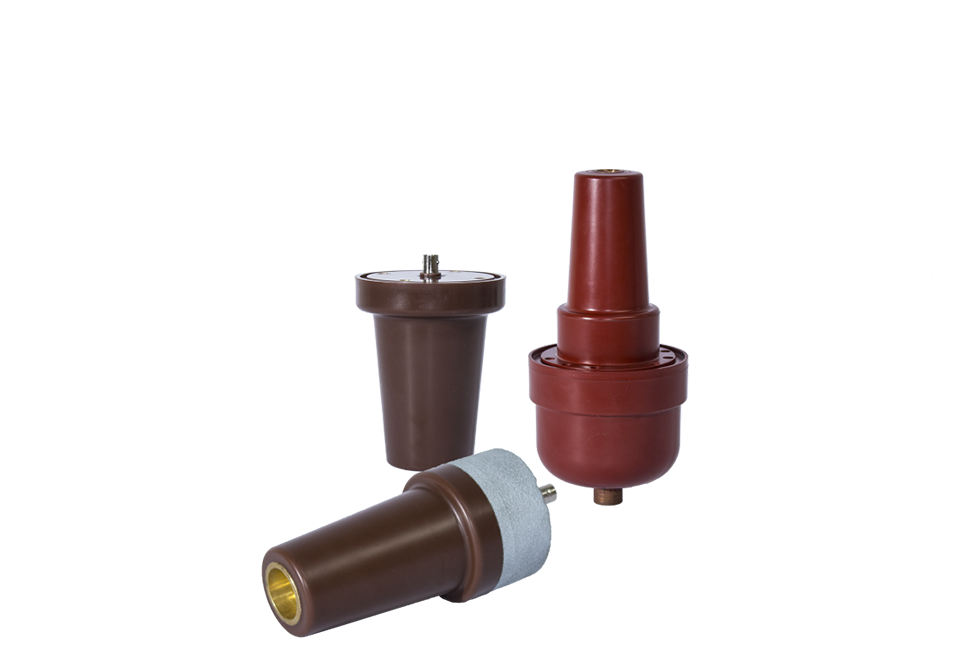
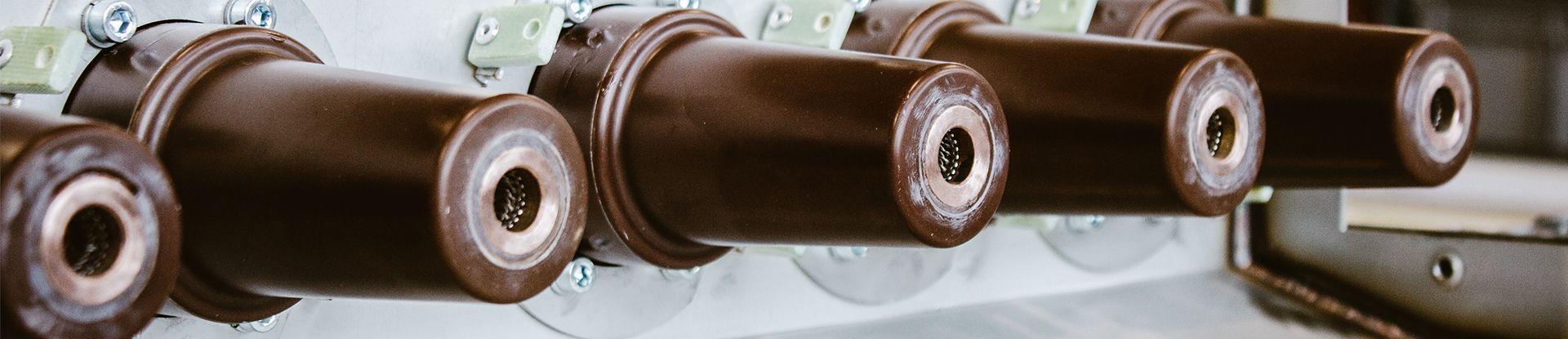

An epoxy support insulator holds a live conductor away from earth while carrying mechanical load at the same time. It keeps the energised parts of the equipment physically separated from the structure around them — which is what protects the installation, the people near it, and the continuity of service.
Indisol casts support and post insulators in epoxy resin, engineered to each application rather than picked from a catalogue: low, medium, high and very high voltage, indoors, outdoors, or in special environments such as SF6 and other dielectric fluids.
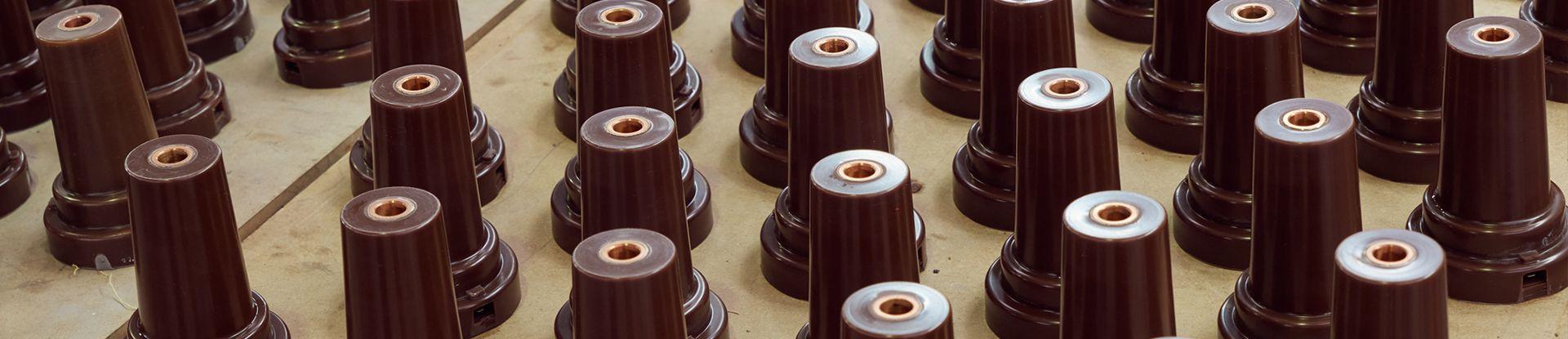
Because the part is cast rather than fired or machined, the geometry is yours to choose. Ribs, creepage profiles, mounting features and fixing centres are moulded in one piece, and threaded inserts or electrodes are encapsulated inside the resin instead of bolted on afterwards — no fasteners sitting in the insulating path.
Mechanical specification follows the duty: traction, bending or torsion. Mounting lashings follow the relevant standard or your own interface.
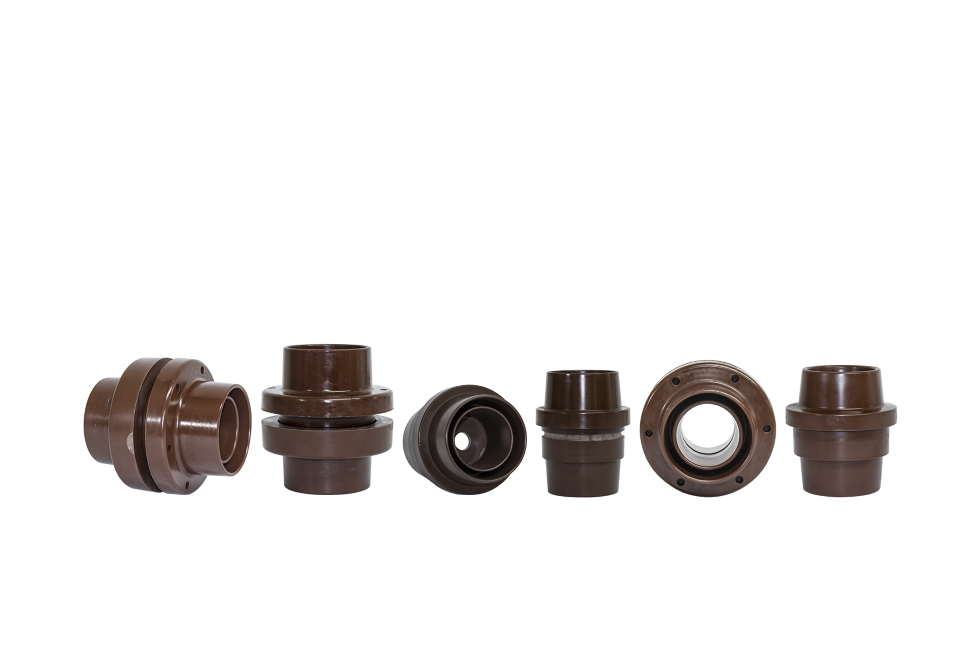
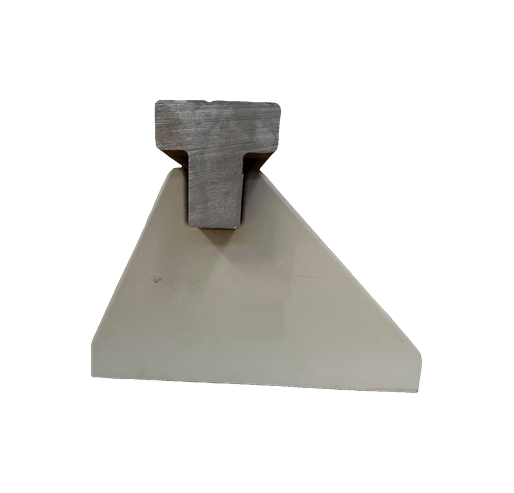
Looking for a different epoxy insulator? Bushings, GIS parts, dividers, sensors, third rail and custom housings are all cast here too — the guide below points you to the right one.
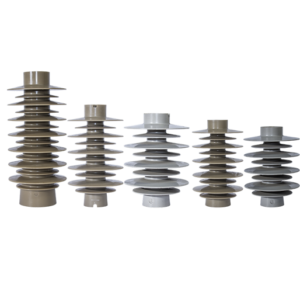
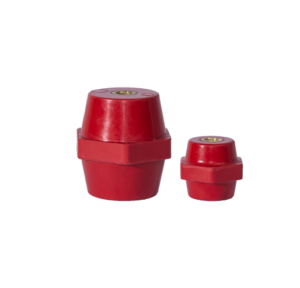
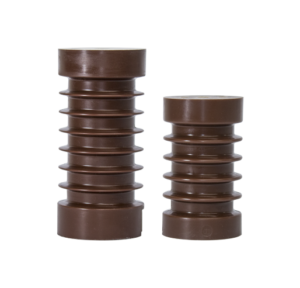
Cast epoxy support and post insulators
Which epoxy insulator do you need?
“Epoxy insulator” is a family name, not a part number. A support insulator is one member of it. If the part you are specifying does something else, go straight to the right family.
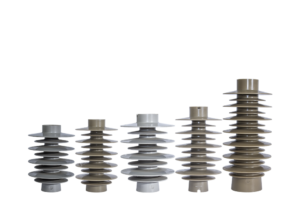
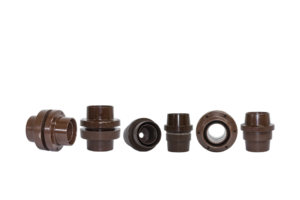
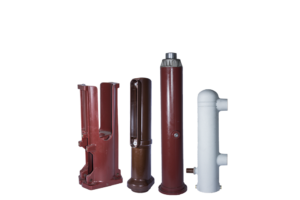
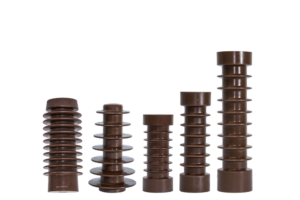
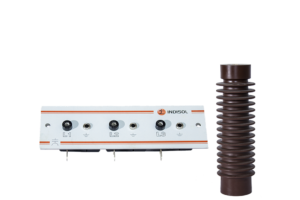
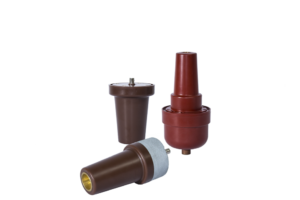
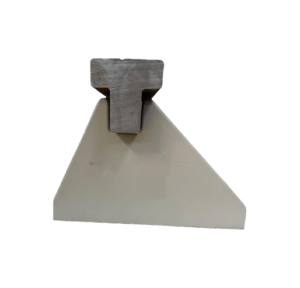
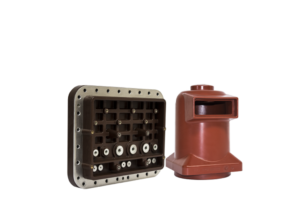
Indoors or outdoors: the resin decides
This is the first thing we will ask you, and it is settled by where the insulator lives rather than by the voltage. Both families cover low, medium, high and very high voltage.
Where neither standard family suits the duty, resin systems can be developed to specific electrical, thermal and mechanical requirements. More on our epoxy resin technology.
How a support insulator is made
Most of what can go wrong electrically goes wrong during casting, which is why the process matters more than the datasheet.
Specified to your duty, then tested
Cast epoxy has a breakdown strength of 20 to 40 kV/mm depending on the system. That is a material figure: it tells you the resin has a large margin, not the withstand voltage of a finished insulator. That also depends on the creepage path along the surface, the clearances through air and the field distribution around any embedded metal — so we dimension the part to your system voltage rather than calculating it from the material alone.
Mechanically, a support insulator usually carries load as well as voltage. Tell us the load and its direction — traction, compression, bending or torsion — and any deflection limit, and the section and fixings are designed to it. Mounting lashings follow the relevant standard or your own interface.
For gas insulated applications, where the electrical stress is highest, every single piece is tested rather than a sample: industrial frequency, partial discharges and X-ray examination of the casting.
The standard range
Nine families, from 1 kV terminal blocks to 72,5 kV long-creepage posts, all cast in epoxy resin and electrically tested. Pick the family by duty, then open it for every reference, with dimensions, creepage, thread sizes and weight.
Block types H, B and TIndoor, busbar and terminal support12 – 425 – 5630 – 67—10 refs
Low-voltage blocks and short posts. Flexural strength varies by reference.
| Reference | Type | RatedkV | FlexuralkN | Heightmm (A) | Body⌀ mm (B) | Flange⌀ mm (C) | Shed ⌀mm (F) | Top thread(M) | Base thread(N) | Creepagemm | Weightkg | |
|---|---|---|---|---|---|---|---|---|---|---|---|---|
| 150100030 | T-793 | 1 | 2 | 40 | 30 | 25 | — | M6 | M6 | 40 | 0,050 | |
| 150100040 | T-760 | 1 | 4 | 40 | 40 | 35 | — | M10 | M10 | 40 | 0,080 | |
| 15012030 | T-793 L25 | 1 | 2 | 25 | 29 | 26 | — | M6 | M6 | 30 | 0,040 | |
| 150100010 | H-35 | 1 | 2 | 35 | 20 | 20 | 30 | M8 | M8 | 36 | 0,035 | |
| 150120010 | H-35 MF | 1 | 2 | 35 | 20 | 20 | 30 | M8 | M8 | 36 | 0,035 | |
| 150100020 | H-50 | 1 | 4 | 50 | 30 | 30 | 40 | M10 | M10 | 51 | 0,090 | |
| 150120020 | H-50 MF | 1 | 4 | 50 | 30 | 30 | 40 | M10 | M10 | 51 | 0,090 | |
| 150100050 | T-120 | 1 | 2 | 55,7 | 40 | 35 | — | M10 | M8 | 66,5 | 0,100 | |
| 150100060 | B-45 | 1 | 2 | 45 | 24 | 24 | 34 | M6 | M6 | 60 | 0,035 | |
| 150100070 | B-50 | 1 | 2 | 50 | 22 | 22 | 34 | M8 | M8 | 65 | 0,060 |
Series T/RIndoor posts, 3 to 6 kV3 – 64 – 1640 – 6058 – 95—4 refs
Metallic insert size and location may be modified.
| Reference | Type | RatedkV | FlexuralkN | Heightmm (A) | Body⌀ mm (B) | Flange⌀ mm (C) | Basemm (D) | Top thread(M) | Base thread(N) | Creepagemm | Weightkg | |
|---|---|---|---|---|---|---|---|---|---|---|---|---|
| 150100080 | T-500/R | 3 | 4 | 40 | 50 | 50 | 36 | M8 | M8 | 58 | 0,120 | |
| 150100090 | T-1000/R | 6 | 4 | 60 | 65 | 60 | 36 | M12 | M12 | 92 | 0,300 | |
| 150100100 | T-2000/R | 6 | 8 | 60 | 90 | 85 | 60 | M16 | M16 | 92 | 0,600 | |
| 150100110 | T-5000/R | 6 | 16 | 60 | 125 | 125 | 80 | M20 | M16 | 95 | 1,400 |
Series SOIndoor, conical body3 – 12880 – 13080 – 130—2 refs
Flexural strength 8 kN (8 000 N) across the family.
| Reference | Type | RatedkV | Heightmm (A) | Body⌀ mm (B) | Flange⌀ mm (C) | Top thread(M) | Base thread(N) | Creepagemm | Weightkg | |
|---|---|---|---|---|---|---|---|---|---|---|
| 150100290 | SO-3 | 3 | 80 | 75 | 55 | M16 | M16 | 80 | 0,350 | |
| 150100292 | SO-10 | 12 | 130 | 75 | 55 | M16 | M16 | 130 | 0,750 |
Series 400Indoor posts, medium voltage7,5 – 36495 – 310155 – 398JO 4 60 … JO 4 1709 refs
Flexural strength 4 kN (4 000 N) across the family. Top insert M16, base insert M12 on every reference.
| Reference | Type | IEC 60273 | RatedkV | Heightmm (A) | Body⌀ mm (B) | Flange⌀ mm (C) | Creepagemm | Shedsn.º | Weightkg | |
|---|---|---|---|---|---|---|---|---|---|---|
| 150100125 | AE-7,5 S4 | JO 4 60 | 7,5 | 95 | 51 | 53 | 155 | 4 | 0,400 | |
| 150100130 | AE-10/12 S4 | — | 10 | 120 | 57 | 53 | 170 | 4 | 0,500 | |
| 150100140 | AE-20 Red S4 | JO 4 75 | 12 | 130 | 58 | 53 | 184 | 4 | 0,600 | |
| 150100150 | AE-17,5/20 S4 | JO 4 95 | 17,5 | 175 | 60 | 52 | 246 | 7 | 0,700 | |
| 150100160 | AE-20/24 S4 | JO 4 125 | 24 | 210 | 65 | 52 | 254 | 7 | 0,900 | |
| 150120160 | AE-20/24 S4 L225 | JO 4 125 | 24 | 225 | 65 | 52 | 269 | 7 | 1,000 | |
| 150100170 | AE-36 Red S4 | JO 4 145 | 27 | 270 | 70 | 60 | 362 | 7 | 1,500 | |
| 150100180 | AE-30/36 S4 | JO 4 170 | 36 | 300 | 74 | 61 | 388 | 7 | 1,600 | |
| 150100190 | AE-36/36 S4 L310 | JO 4 170 | 36 | 310 | 74 | 61 | 398 | 7 | 1,700 |
Series 800Indoor posts, higher mechanical load10 – 528120 – 420218 – 690JO 8 75 … JO 8 1708 refs
Flexural strength 8 kN (8 000 N) across the family.
| Reference | Type | IEC 60273 | RatedkV | Heightmm (A) | Body⌀ mm (B) | Flange⌀ mm (C) | Creepagemm | Shedsn.º | Top thread(M) | Base thread(N) | Weightkg | |
|---|---|---|---|---|---|---|---|---|---|---|---|---|
| 150100192 | AE-10/12 S8 | — | 10 | 120 | 59 | 71 | 218 | 5 | M20 | M16 | 0,700 | |
| 150100196 | AE-20 Red S8 | JO 8 75 | 12 | 130 | 60 | 71 | 228 | 5 | M20 | M16 | 0,750 | |
| 150100202 | AE-17,5/20 S8 | JO 8 95 | 17,5 | 175 | 67 | 71 | 466 | 10 | M20 | M16 | 1,250 | |
| 150100200 | AE-20/24 S8 | JO 8 125 | 24 | 210 | 70 | 71 | 501 | 10 | M20 | M16 | 1,600 | |
| 150100212 | AE-36 Red S8 | JO 8 145 | 27 | 270 | 75 | 70 | 584 | 15 | M20 | M16 | 2,000 | |
| 150100210 | AE-30/36 S8 | JO 8 170 | 36 | 300 | 75 | 70 | 690 | 15 | M24 | M16 | 2,200 | |
| 150100220 | AE-45 S8 | — | 45 | 350 | 96 | 105 | 640 | 12 | M24 | M16 | 4,500 | |
| 150100230 | AE-52 S8 | — | 52 | 420 | 115 | 70 | 650 | 14 | M24 | M16 | 4,200 |
Series AEIIndoor, longer leakage line12 – 308130 – 280385 – 627JO 8 753 refs
Flexural strength 8 kN (8 000 N). Top insert M20, base insert M16.
| Reference | Type | IEC 60273 | RatedkV | Heightmm (A) | Body⌀ mm (B) | Flange⌀ mm (C) | Shed ⌀mm (F) | Creepagemm | Weightkg | |
|---|---|---|---|---|---|---|---|---|---|---|
| 150100250 | AEI-10 | JO 8 75 | 12 | 130 | 72 | 72 | 100 | 385 | 0,900 | |
| 150100260 | AEI-20 | — | 24 | 210 | 70 | 70 | 100 | 580 | 2,600 | |
| 150100270 | AEI-30 | — | 30 | 280 | 80 | 80 | 170 | 627 | 4,100 |
Series EIRIndoor, high mechanical load3016300770JO 16 1701 ref
Flexural strength 16 kN (16 000 N). Top insert M24, base insert M16.
| Reference | Type | IEC 60273 | RatedkV | Heightmm (A) | Body⌀ mm (B) | Flange⌀ mm (C) | Shed ⌀mm (F) | Creepagemm | Weightkg | |
|---|---|---|---|---|---|---|---|---|---|---|
| 150100280 | EIR-30 | JO 16 170 | 30 | 300 | 110 | 110 | 150 | 770 | 5,600 |
Series AERIndoor, long leakage line, up to 72,5 kV20 – 72,54 – 8210 – 620388 – 1 295—3 refs
Flexural strength varies by reference.
| Reference | Type | RatedkV | FlexuralkN | Heightmm (A) | Body⌀ mm (B) | Flange⌀ mm (C) | Creepagemm | Shedsn.º | Top thread(M) | Base thread(N) | Weightkg | |
|---|---|---|---|---|---|---|---|---|---|---|---|---|
| 150100238 | AER-20 | 20 | 4 | 210 | 105 | 60 | 388 | 7 | M16 | M10 | 1,500 | |
| 150100239 | AER-30 | 30 | 4 | 300 | 130 | 85 | 647 | 10 | M16 | M10 | 3,250 | |
| 150100239 | AER-72,5 | 72,5 | 8 | 620 | 200 | 120 | 1 295 | 15 | M24 | M16 | 16,000 |
Series AETCapacitive, for voltage measurement12 – 364130 – 300228 – 690JO 4 75 … JO 4 1704 refs
Capacitive insulators. Top insert M16, base insert M12, with M5 measuring tap.
| Reference | Type | IEC 60273 | RatedkV | Heightmm (A) | Body⌀ mm (B) | Flange⌀ mm (C) | Creepagemm | Weightkg | |
|---|---|---|---|---|---|---|---|---|---|
| 150100390 | AET-12 kV | JO 4 75 | 12 | 130 | 60 | 71 | 228 | 0,700 | |
| 150100395 | AET-17,5 kV | JO 4 95 | 17,5 | 175 | 67 | 71 | 466 | 1,300 | |
| 150100400 | AET-24 kV | JO 4 125 | 24 | 210 | 70 | 71 | 501 | 1,600 | |
| 150100410 | AET-36 kV | JO 4 170 | 36 | 300 | 75 | 70 | 690 | 2,200 |
Dimensions and weights are catalogue values for the standard range; the drawing letters (A, ⌀B, ⌀C, D, F, M, N) are the marks used on our dimensioned drawings. Thread pitches follow UNE 21-110-83 (2) and IEC 60273 and can be changed to DIN 48136 on request; insert size and position can be modified. Need a voltage, a load or a height that is not in the range? We cast to drawing — send us the duty and we come back with a proposal.
Common questions
Send us the duty. We will design the insulator to it.
Every part we cast is engineered to a specification rather than selected from a catalogue, so you will get a design proposal back, not a page number. You do not need all of the detail to start.
Request a quotation → or see how we cast them